How to Upgrade Your Smoking Cessation Counseling Services to Achieve Higher Profits Instead of Just Low-Price Competition
Why low-price competition drains smoking cessation counseling — analyzing four fatal flaws of the low-price model
Why low-price competition drains smoking cessation counseling — analyzing four fatal flaws of the low-price model
# How to Upgrade Your Smoking Cessation Counseling Services to Achieve Higher Profits Instead of Just Low-Price Competition
In March 2023, I rented half a room in a co-working space in Binjiang, Hangzhou, and hung up a "Smoking Cessation Counseling" sign to take clients. My approach at that time was very crude: a 9.9 yuan experience session on WeChat Moments, and "30-minute consultation for 39 yuan" in private traffic. In the first month, 87 people came in. The cash flow looked lively, but when I settled accounts at the end of the month, I had lost nearly 120 hours of my own time, not counting the time spent on reviews and being bombarded on WeChat late at night. What really changed my mind wasn't a theory class — it was three consecutive days in mid-April when people asked for refunds, with almost the same reason: "It's about the same as the free articles online."
After that, I stopped making low prices my main battlefield and instead split my service into two things: standardized deliverables that can be replicated, and personalized experiences that people are willing to pay for. Without either one, you either can't stabilize or can't charge a premium.
1. Why Low-Price Competition Drains Smoking Cessation Counseling
Standardized delivery: first build a solid base that can command a premium — service breakdown, script toolkit, quality metrics
For smokers trying to quit on their own, the common figure in literature and clinical experience is about 3%–5% who can stay smoke-free for 6–12 months; most people relapse within the first 8 days of trying. Professional support (counseling + medication/alternatives when needed) can significantly raise success rates — some outpatient clinics with good long-term management have reported over 80% phased success rates, but that's the result of high-intensity follow-up, individual plans, and screening, not something replicable with 39 yuan for half an hour.
The real cost of low-price counseling isn't "39 yuan for half an hour," it's:
From March to April 2023, I tracked my WeChat: each 39-yuan client would send 6–11 follow-up messages, distributed from 9 PM to 1 AM. The effective service time often exceeded 90 minutes, dropping my hourly wage to just over 20 yuan — less than a convenience store part-time job.
Some wanted to "quit immediately," others only dared to "cut down first," and some were simultaneously anxious, insomniac, and worried about weight. I didn't have an assessment form — I improvised on the spot. As a result, with the same 39 yuan, some felt I "hit the point," while others felt it was "generic talk." With such variance in word-of-mouth, repeat purchases were nearly zero.
Once a client bought "counseling" for 39 yuan, pitching an 8-week 1980-yuan program felt like jumping from a night market to a private kitchen. At that time, my conversion rate for the 8-week package was only 4.2% (3 out of 87 people), and 2 of those were referrals from acquaintances.
Low-price clients often have weak motivation and poor environmental support. When they relapse, they don't say "I didn't follow through" — they say "counseling doesn't work." The more active you are in the low-price pool, the more negative samples you accumulate.
Public data also shows that "service" itself has economic value: in some US medical systems, eligible smoking cessation counseling can be billed, but actual billing rates are extremely low (one study found about 1% of eligible visits billed for cessation-related costs), with potential losses over four years reaching millions of dollars. The point is simple: professional smoking cessation services aren't "only reasonable as free charity" — what's being missed is measurable service value. The question is: are you selling "a half-hour chat" or "a verifiable process of change"?
My conclusion is firm: Relying on low prices topile up volume, smoking cessation counseling won't grow profits — it will only pile up exhaustion.
2. Standardized Delivery: First Build a Solid Base That Can Command a Premium
Personalization: where premium pricing really happens — tiering, menu-style add-ons, visible node output
Many people think premium pricing comes from "being better at talking." I tried that — being articulate only makes individual sessions satisfactory, not profits stable. The first real lever for raising profits is standardization.
1. Cut the service into phase packages, not "answer any question anytime"
In May 2023, I took two weeks to split the service into four phases and wrote them into a one-page delivery manual (sent to the client immediately after payment):
| Phase | Duration | Standard Actions | Client's Required "Homework" |
|---|---|---|---|
| ------- | ---------- | ----------------- | ------------------------------ |
| Assessment | Days 0–3 | Smoking history, rough nicotine dependence assessment, 10 trigger scenarios, quit window selection | Fill form + 3-day smoking diary |
| Initiation | 7 days around quit day | Withdrawal symptomcontingency plan, alternative action checklist, environment de-smoking | Daily check-in + 1 voice message at crisis moments |
| Consolidation | Weeks 2–4 | High-risk relapse scenario drills, weight/emotion/sleep three-in-one | Weekly review form |
| Stabilization | Weeks 5–8 | Identity shift ("I don't smoke" scripts), social situation strategies | Bi-weekly video session |
Each phase has a fixed agenda and overtime rules: single video session defaults to 40 minutes; up to 10 minutes overtime is free, beyond that it's carried over to the next session. Clients who previously wanted to "talk until satisfied" now know the boundaries; I also transformed from a late-night customer service agent back into a counselor.
2. Scripts and toolkits: let newcomers also deliver a 70-point result
I built three sets of tools for myself and the assistants I later trained:
In studies like the California Smokers' Helpline, structured protocols + training (e.g.,tens of hours of unified training) are key to quality assurance. I condensed the same logic into a "small-workshop version": not pursue helpline scale, but the same problem gets a consistent answer framework from different counselors. The client pays for a system, not a star consultant's improvisation.
3. Manage quality with a few metrics, not "feels okay"
I only track four numbers (half-hour review every Friday afternoon):
After standardization launched in June 2023, I raised the single session experience price from 39 to 198 yuan/50 minutes (including a one-page written assessment summary), and the 8-week program from a tentative "want to sell at 1980" to 3280 yuan (including 6 video sessions + text follow-up quota). The conversion rate from experience session to package fluctuated between 18%–22% by the end of August — a big jump from 4.2%. It wasn't that my talking skills suddenly improved; it was that clients clearly understood "what they're buying and what they need to do."
The profit logic of standardization is straightforward: marginal delivery cost decreases, quality variance decreases,reputation becomes predictable — only then can you raise prices.
3. Personalization: Where Premium Pricing Really Happens
Product matrix: from low-price traffic to profit pool — four-layer structure design and pricing strategy
If you only have standard processes, you become an "expensive instruction manual." People willing to pay more are buying: being treated precisely within a standard framework.
1. Tier, not "full package for everyone"
In July 2023, I classified clients into three tiers based on assessment results (internal code, never say "you're a C-tier" to clients):
Example: a Hangzhou internet company project manager, 35, 12 cigarettes/day, wife pregnant. Delivery focus: fast launch + high-pressure work scenario drills. Standard package is sufficient; personalization only adds "business trip hotel trigger checklist."
Example: a Yiwu foreign trade boss with many social engagements. Personalization needed: "dinner party scripts," "identity positioning of drinking only without smoking," "driver/assistant coordination." This type can reach 4980 yuan/12 weeks, because what's saved isn't just cigarette money — it's image and health crisis awareness.
Clearly state: counseling cannot solve all of depression/anxiety; recommend medical collaboration. I rejected two requests for low-price long chats from people who just wanted to be "scolded awake" — the time saved went to serving A/B clients, and both profit and mental clarity improved.
A Peking University-related team did a personalized information intervention comparison using WeChat mini-programs: the personalized group had a CO-verified continuous abstinence rate of about 6.9% at 6 months, versus about 3.0% for the non-personalized group. The numbers vary by population, but I agree with the direction: sending the same content to everyone is worse than adjusting trigger points and scripts per person.
2. Personalization must be "deliverable and billable," not unlimited customization
I only open four types of add-on items (2023 pricing, for reference):
| Add-on | Content | Price at the time |
|---|---|---|
| -------- | --------- | ------------------- |
| Partner/family coordination session | 1 session of 40 min, teaching family how to help without pushing | +400 yuan |
| Workplace socializingspecialized module | 3 real-world scenarios scripts + 1 simulation | +600 yuan |
| High-intensity withdrawalcompanion program | 14 days of daily briefings from quit day + 2 emergency call quotas | +900 yuan |
| Relapse restart pack | Can be activated if relapse within 30 days, includes 2 video sessions | Included once in package; repurchase +1200 yuan |
Key discipline: personalization = choosing from a menu, not rewriting the contract every time a client thinks of something.
In August 2023, a client requested "1 hour of video every day." I quoted it atapproaching full-time consultant rates, and he gave up. I felt no guilt — unlimited customization would eat up standardized profits.
3. Use "visible nodes" to prove personalization isn't fluff
After each video session, I consistently output three things (template-based, 5–8 minutes to fill):
The client feels it's "written for me," but behind the scenes it's a standard template + field replacement. Personalized experience, standardized backend — this is the core of premium pricing without exploding costs.
4. Product Matrix: From Low-Pricetraffic generation to Profit Pool
A real transformation: numbers speak louder than slogans — key data comparison before and after upgrade
The restructured model (actually used in the second half of 2023):
Public accounts and short videos talk about quit timelines, misconceptions, oral and respiratory changes. Only responsible for trust, not for profit.
50 minutes + one-page assessment summary. Purpose: screen motivation, build authority, provide package anchor. Don't seek big profits at this layer — seek conversion and rejecting unsuitable people.
8–12 week standardized phase package + menu-style personalized add-ons. Target gross margin (after venue and basic tools) to reach 60%+. After time accounting, my effectiveinvestment input per client is about 6–9 hours of video + equivalent 3–4 hours of text, making the hourly wage look like a real business.
For those who've completed 8 weeks but fear social relapse. Renewal is much cheaper than acquiring new clients and stabilizes reputation.
I didn'tcompletely kill low prices, but I downgraded them to a screening tool,no longer as theprimary SKU. Anyone insisting on "39 yuanfull-process companion program" I politely recommend public smoking cessation clinics or hotlines — that's a different public product line, not the same model as my private high-service approach.
5. A Real Transformation: Numbers Speak Louder Than Slogans
A few views I hold — you can disagree, but this is how I make money
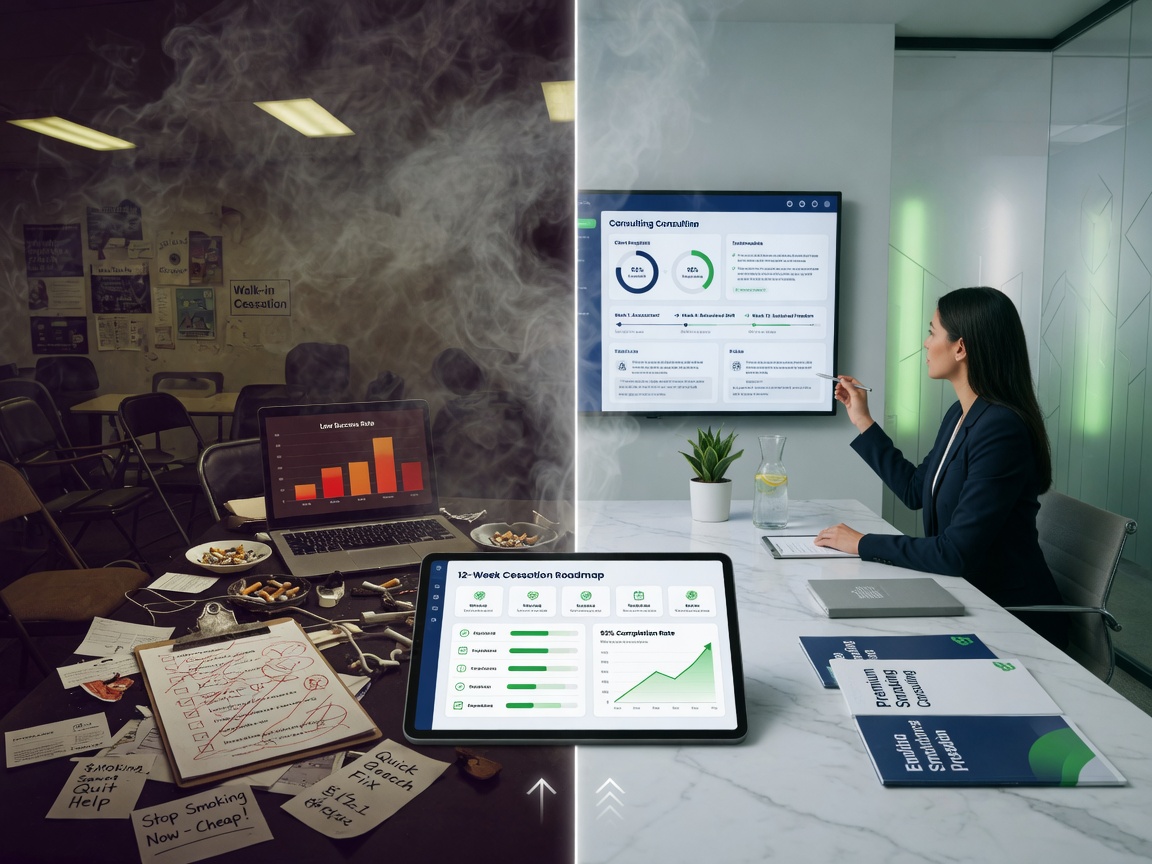
Comparing March–April 2023 (low-price period) with July–September 2023 (after standardization + personalization launched) — a personal small sample, not a paper, but enough to guide oneself:
| Metric | Low-price period (~2 months) | After upgrade (~3 months) |
|---|---|---|
| -------- | ------------------------------ | --------------------------- |
| Experience/consultation price | 9.9–39 yuan | 198 yuan |
| Main package | 1980 almost unsellable | 3280 / 4980 |
| Experience→package conversion | ~4.2% | 18%–22% |
| Effective service hours per client (package) | Out of control, often exceeded expectations | Target 9–13 hours |
| Late-nightnuisance interruptions | High frequency | Significantly reduced outside crisis channel |
| Subjective feeling | Busy, resentful, afraid to raise prices | Scheduleable, able to say no, profits visible |
Honest about the pitfalls I stepped in:
6. A Few Views I Hold (You Can Disagree, But This Is How I Make Money)
Minimum action list if you want to change now — start with five steps
First, the profit of smoking cessation counseling doesn't come from "being cheaper" — it comes from "verifiable behavior change per unit of time."
Clients buy cigarettes for instant gratification; they buy quitting for delayed benefits. You must use phase packages, node outputs, and review forms to break delayed benefits into visible progress, or they'll only compare prices.
Second, standardization is responsible to both the client and the profit.
Without standards, your ability can't be replicated, you can't hire a team, and you're forever an hourly worker. Community smoking cessation programs in places like Shenzhen are pushing digital case management and automated follow-up plans — same direction: standard follow-up + professional judgment. A personal consulting room may not have a big system, but it must have forms and SOPs.
Third, personalization is a premium add-on, not a moral obligation of unlimited supply.
True professionalism includes knowing how to say "this is outside our service scope" and "you'd better see a doctor first."
Fourth, price wars are particularly stupid in the smoking cessationspace.
Because the natural failure rate isn't low; low pricesmagnify failure samples. A high-service model allows you to screen motivation, require cooperation, and do follow-ups. WHO and other institutions emphasize that professional support can significantly improve success rates — if you're selling professional support, price it as a professional service, not at "the price of an online article."
Fifth, the order of service upgrade must be: standardize first, personalize second, raise prices third; reversing the order will backfire.
If you raise prices first but the delivery still feels like casual chat, refunds will teach you a lesson. I learned from refunds before I wrote the order into my own operating manual.
7. Minimum Action List If You Want to Change Now
You don't need to roll out the full 12-week system at once. Start with these five steps (this is exactly how I launched in May 2023):
After these five steps, your counseling is still helping people quit smoking, but the business model has shifted from "trading time forfavor" to "using a system for results and profit."
Low prices can be an entry point, but don't let them be your destination. Standardization lets you live long, personalization lets you sell high — do both together, and smoking cessation counseling becomes a sustainable professional service, not a competition of who can undervalue themselves more.
Low-price period (Mar-Apr 2023)
9.9-39 yuan experience sessions,依靠 volume, hourly wage lower than convenience store part-time
After upgrade (Jul-Sep 2023)
198 yuan assessment + 3280/4980 yuan package, gross margin 60%+, scheduleable, able to say no